This post contains affiliate links. I may earn a small commission if you purchase through my links, at no extra cost to you.”
Teaspoon Measurements Explained: The Beginner’s Complete Guide to Measuring Spoons in Cooking & Baking
Kitchen Basics · Beginner Friendly
Tiny Spoon, Big Difference , Measure Right Every Time
Everything you need to know about teaspoons before your next step
You’ve found a recipe you’re excited to try, you’ve gathered your ingredients and then you see it: “Add 1 tsp of vanilla extract.” Simple enough, right? But what if you’re not sure whether to pack it, level it, heap it, or whether that little spoon in your drawer is even the right size?
If you’re new to cooking and baking, teaspoon measurements can feel surprisingly tricky. At My Kitchen My Home, we believe the kitchen should feel welcoming to everyone, so here’s your complete, no-jargon guide to understanding teaspoons, using them correctly, and choosing the best measuring spoons for your kitchen.
A teaspoon (abbreviated “tsp”) holds exactly 5 milliliters (ml) of liquid. Three teaspoons equal one tablespoon. That’s the foundation, everything else builds from there!
What Exactly Is a Teaspoon?
A teaspoon is a standard unit of measurement used in cooking and baking across the United States, Canada, Australia, and many other countries. When you see “tsp” in a recipe, it always means teaspoon.
Here’s the important thing to know: the teaspoon in your cutlery drawer and the teaspoon in a measuring spoon set are not the same thing. An everyday spoon you’d stir coffee with can vary wildly in size. A proper measuring teaspoon is standardized and holds exactly 5 ml, no guessing required.
¼ tsp
1.25 ml
A small pinch
½ tsp
2.5 ml
Half a teaspoon
1 tsp
5 ml
One teaspoon
1 tbsp
15 ml
3 teaspoons
Teaspoon Conversions You Need to Know
Once you understand how teaspoons relate to other measurements, reading any recipe becomes much easier. Here are the key conversions every beginner should bookmark:
3 tsp = 1 tbsp
Three teaspoons make one tablespoon, the most important conversion in the kitchen
1 tsp = 5 ml
Helpful when following international recipes that use milliliters instead of spoons
48 tsp = 1 cup
There are 48 teaspoons in a standard US cup, useful to know for scaling recipes
½ tsp = 2.5 ml
A half teaspoon is common for spices and leavening agents like baking powder
¼ tsp = 1.25 ml
The smallest standard measure, often used for salt, pepper, or strong spices
⅛ tsp = a pinch
When a recipe says “a pinch,” it roughly equals ⅛ teaspoon, about what fits between two fingers
Teaspoon Cheat Sheet: Save This!
|
¼ teaspoon |
1.25 ml |
|
|
½ teaspoon |
2.5 ml |
half tsp |
|
1 teaspoon |
2.5 ml |
1tsp |
|
1 tablespoon |
15 ml = 3 tsp |
1 tbsp |
|
2 tablespoons |
30 ml = 6 tsp |
⅛ cup |
|
¼ cup |
60 ml = 12 tsp |
4 tbsp |
How Teaspoons Are Used in Cooking
In everyday cooking, soups, sauces, marinades, dressings , teaspoons are used to measure smaller quantities of flavor-forward ingredients. Because cooking is generally more forgiving than baking, you have a little wiggle room. But measuring still matters for balance and consistency.
Spices & Seasonings
Cumin, paprika, garlic powder, chili flakes, almost all dry spices are measured in teaspoons. Too much can overpower a dish.
e.g., 1 tsp cumin in chili
Oils & Sauces
Small amounts of sesame oil, fish sauce, or hot sauce are measured in teaspoons, where a tablespoon would be too much.
e.g., 1 tsp sesame oil in stir-fry
Dried Herbs
Dried oregano, thyme, rosemary, and basil are potent, teaspoons let you add flavor without overwhelming the dish.
e.g., ½ tsp dried thyme in soup
Garlic & Ginger Paste
Minced garlic, ginger paste, or tomato paste are often measured in teaspoons in sauces, curries, and stews.
e.g., 2 tsp garlic paste in curry
In savory cooking, teaspoon measurements are guidelines. Taste as you go, and adjust seasoning at the end. A dish that needs “1 tsp of salt” might need more or less depending on your ingredients.
How Teaspoons Are Used in Baking
Baking is chemistry, and in chemistry, precision counts. This is where accurate teaspoon measurements become truly important. Too much baking soda and your cake tastes metallic. Too little yeast and your bread won’t rise. Unlike cooking, baking doesn’t forgive improvisation easily.
Baking Soda & Powder
These leavening agents make baked goods rise. Even ¼ tsp too much can affect texture and taste. Always measure exactly.
e.g., 1 tsp baking powder in muffins
Vanilla Extract
One of the most common baking ingredients. Typically, 1 tsp per batch is enough to flavor without making it taste artificial.
e.g., 1 tsp vanilla in cookies
Salt in Baking
Salt enhances sweetness and balances flavor in baked goods. Even sweet recipes call for ¼ to ½ tsp, don’t skip it!
e.g., ½ tsp salt in banana bread
Spices & Zest
Cinnamon, nutmeg, cardamom, and citrus zest are added by the teaspoon to add warmth and complexity to baked treats.
e.g., 1 tsp cinnamon in apple pie
Always level off your measuring spoon with a flat edge (like the back of a knife) when measuring dry ingredients. A heaped teaspoon can be up to 50% more than a leveled one, and that can completely change your results.
Common Measuring Mistakes Beginners Make
Even small errors with teaspoon measurements can throw off a recipe. Here are the most common slip-ups and how to avoid them:
Using a regular spoon from the drawer. A dinner spoon or coffee spoon isn’t standardized, it can hold anywhere from 2 ml to 8 ml. Always use a proper measuring spoon set.
Heaping dry ingredients. A heaped teaspoon of baking soda or flour is much more than a level one. For baking, always sweep off the excess with a straight edge.
Measuring over the bowl. If you measure spices or liquids directly over your mixing bowl and spill, you’ve just added more than intended with no way to take it back. Measure over the counter or a separate bowl.
Packing dry ingredients like brown sugar. Brown sugar should be packed; flour and spices should not. Always follow the recipe’s instruction , “1 packed tsp” vs. “1 tsp” are different amounts.
Confusing tsp and tbsp. A tablespoon (tbsp) is 3× the size of a teaspoon (tsp). Mixing these up. Especially with salt, baking soda, or spices, it can ruin a dish. When in doubt, double-check the abbreviation.
How to Choose the Right Measuring Spoons
Not all measuring spoons are created equal. Here’s what to look for when shopping, especially if you’re building out your kitchen toolkit:
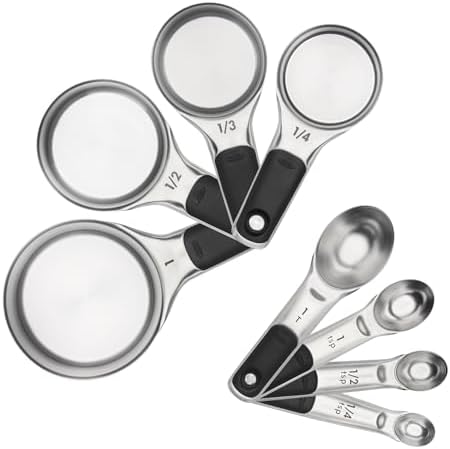
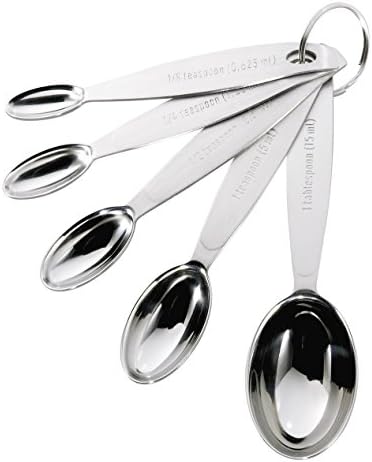
Material matters. Stainless steel spoons are the gold standard, they’re durable, rust-resistant, easy to clean, and won’t absorb odors or stains like plastic can over time. Plastic works fine for occasional use and tends to be more colorful and budget-friendly.
Size set. A good set includes at a minimum: ¼ tsp, ½ tsp, 1 tsp, and 1 tbsp. Better sets add ⅛ tsp and 1½ tsp for more precision.
Shape of the spoon head. Oval or round heads are traditional. Long, narrow spoons are designed to fit inside spice jars, a small but very practical feature for home cooks.
Clearly marked measurements. Look for measurements engraved or embossed on the handle, not just printed. Printing fades with washing over time.
Stackable or ring-linked sets. Ring-linked sets keep spoons together so you never lose one. Stackable sets are magnetic or clip-together and look beautiful on a counter.
Stainless Steel
Durable and long-lasting
Dishwasher safe
Won’t stain or absorb smells
Professional look & feel
Very accurate
Plastic / Basic Sets
Fading printed labels
Can warp with heat
May absorb odors over time
Less durable long-term
Budget-friendly to start
Our Top Measuring Spoon Picks for Beginners


What does “tsp” mean in a recipe?
Tsp is the abbreviation for teaspoon. It equals 5 milliliters (ml). You’ll often see it used for spices, salt, vanilla extract, baking soda, baking powder, and other small-quantity ingredients in recipes.
What’s the difference between a teaspoon and a tablespoon?
A tablespoon (tbsp) is exactly 3 times larger than a teaspoon (tsp). One tablespoon = 15 ml; one teaspoon = 5 ml. This is one of the most common sources of confusion in cooking , always double-check which one a recipe calls for.
Can I use a regular spoon instead of a measuring spoon?
For savory cooking, you can sometimes get away with it, but it’s not recommended. Regular spoons vary in size and won’t give you consistent results. For baking especially, always use a proper measuring spoon set to ensure accuracy.
How do I measure a teaspoon of a sticky ingredient like honey or peanut butter?
Lightly spray the spoon with cooking spray first , the sticky ingredient will slide right off cleanly. Alternatively, use a silicone spatula to scrape the spoon clean into your bowl. For honey especially, warm the spoon briefly under hot water first.
Do I need a full set of measuring spoons or just one teaspoon?
A full set is strongly recommended. Most recipes call for ¼ tsp, ½ tsp, and 1 tsp, and you’ll often need multiple sizes in a single dish. A standard set (¼, ½, 1 tsp + 1 tbsp) costs under $15 and covers virtually every recipe you’ll encounter.
Is a teaspoon the same measurement worldwide?
Almost, but not quite. In the US, Canada, and Australia, a teaspoon is 5 ml. In the UK, a teaspoon is traditionally 3.5 ml, though most modern UK recipes now use the 5 ml standard. When following recipes from different countries, it’s worth checking which measurement they use