This post contains affiliate links. I may earn a small commission if you purchase through my links, at no extra cost to you.
Introduction: Why Accurate Measurements Matter in Cooking and Baking
Whether you’re a beginner stepping into the kitchen for the first time or a seasoned home cook looking to sharpen your skills, understanding cooking and baking measurements is one of the most fundamental skills you can master. Unlike cooking, where a pinch of this or a splash of that often works just fine, baking is a precise science, the wrong amount of flour, baking powder, or butter can mean the difference between a fluffy cake and a dense brick.
In this comprehensive guide, we’ll walk you through every measurement you’ll encounter in a recipe, explain what they mean, how to convert between them, and share pro tips for measuring accurately every time.
Volume Measurements: The Foundation of Most Recipes
Volume measurements are the most commonly used in everyday cooking and baking, especially in American recipes. Here’s a breakdown of
Teaspoon (tsp)
The teaspoon is the smallest standard unit of volume measurement used in recipes. It’s most often used for:
- Spices (cumin, cinnamon, paprika)
- Leavening agents (baking soda, baking powder)
- Extracts (vanilla, almond)
- Salt
Key facts:
- 1 teaspoon = approximately 5 milliliters (ml)
- 3 teaspoons = 1 tablespoon
- Available in measuring sets as ¼ tsp, ½ tsp, and 1 tsp

When measuring dry spices, fill the measuring spoon and level it off with a straight edge (like the back of a knife) for accuracy.
Tablespoon (tbsp.)
The tablespoon is exactly 3 teaspoons and is used for slightly larger amounts of ingredients. Common uses include:

Pro Tip: For dry ingredients like flour, spoon them into the measuring cup and level off the top — never scoop directly from the bag, as this can compact the flour and add up to 20% more than the recipe calls for.
Fluid Ounce (fl oz)
A fluid ounce is a unit of liquid volume. It’s commonly seen on liquid measuring cups and beverage recipes.
Key facts:
- 1 fluid ounce = approximately 30 ml
- 8 fluid ounces = 1 cup
- 16 fluid ounces = 1 pint
Pint
A pint is commonly used for liquids and some bulk ingredients.
Key facts:
- 1 pint = 2 cups = 16 fluid ounces = approximately 480 ml
- Often seen in recipes for soups, stocks, and cream-based dishes
- In the UK, 1 pint = 568 ml (slightly larger than the US pint)
Quart
A quart is a larger volume unit, used for bigger batches of soups, stews, and beverages.
Key facts:
- 1 quart = 2 pints = 4 cups = 32 fluid ounces = approximately 960 ml
- Most standard saucepans are 2–4 quart capacity
Gallon
The gallon is the largest standard volume measurement used in home cooking, typically for large-batch cooking or liquid storage.
Key facts:
- 1 gallon = 4 quarts = 8 pints = 16 cups = 128 fluid ounces = approximately 3.8 liters
- Commonly used for beverages, brines, and large-batch recipes
Weight Measurements: The Baker’s Best Friend
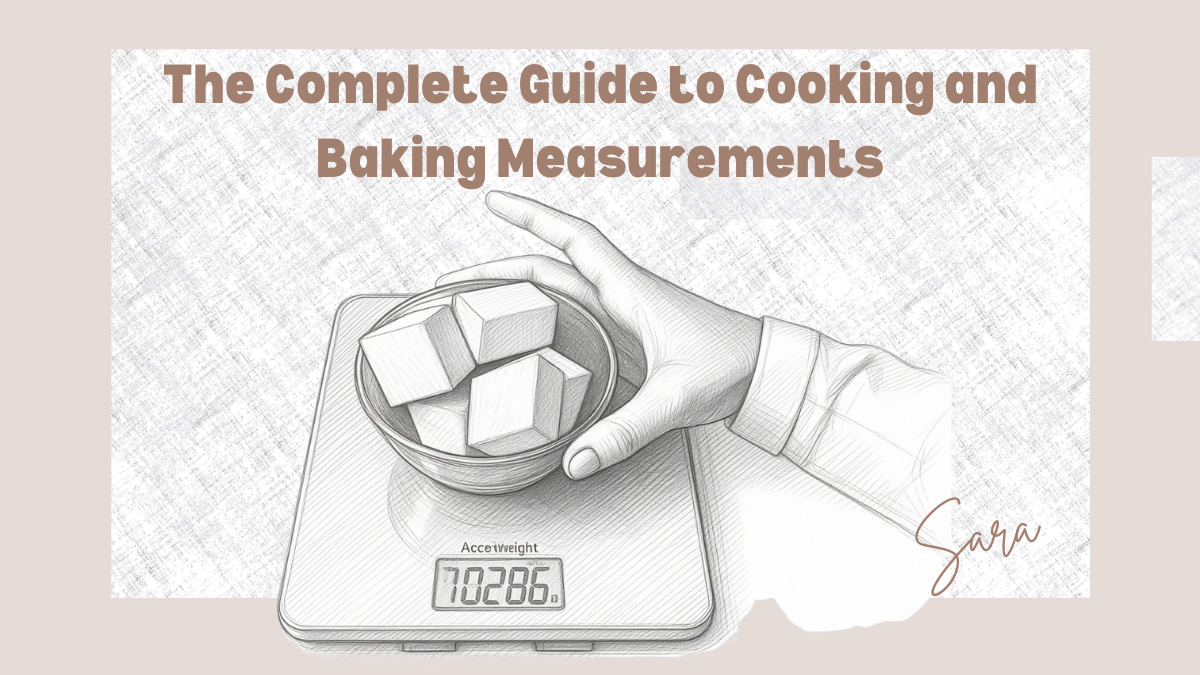
Weight measurements are considered the gold standard in professional baking because they are far more accurate than volume. A cup of flour can vary by 20–30 grams depending on how it’s scooped, but 120 grams of flour is always exactly 120 grams.
Gram (g)
The gram is the metric base unit of weight, widely used in professional and international recipes.
Common ingredient weights:
- 1 cup all-purpose flour ≈ 120–130 g
- 1 cup granulated sugar ≈ 200 g
- 1 cup butter ≈ 227 g
- 1 cup whole milk ≈ 240 g
- 1 teaspoon salt ≈ 6 g
Pro Tip: Invest in a digital kitchen scale that reads in grams. It will be one of the most useful tools in your kitchen, especially for baking.
Kilogram (kg)
A kilogram equals 1,000 grams and is used for larger quantities of ingredients.
Key facts:
- 1 kg = 1,000 g = approximately 2.2 pounds
- Common in commercial recipes and large-batch baking
- Example: A 1 kg bag of flour is enough for about 7–8 cups
Ounce (oz)
The ounce is the imperial unit of weight, commonly used in American recipes alongside cups.
Key facts:
- 1 ounce = 28.35 grams
- 16 ounces = 1 pound
- Often used for chocolate, butter, and cheese
Important: Don’t confuse weight ounces (oz) with fluid ounces (fl oz). They measure different things — weight vs. volume.
Pound (lb)
The pound is the larger imperial weight unit, used for meats, large quantities of produce, and bulk ingredients.
Key facts:
- 1 pound = 16 ounces = approximately 454 grams
- Commonly used for: meat (a 2 lb chicken breast), large blocks of cheese, and bulk flour or sugar purchases
Temperature Measurements: Getting the Heat Right
Temperature is often overlooked as a “measurement,” but it’s absolutely critical — especially in baking.
Fahrenheit (°F)
Fahrenheit is the standard temperature scale used in American recipes.
Common baking temperatures:
| Use | Temperature (°F) |
|---|---|
| Slow roasting | 250–300°F |
| Cookies & cakes | 325–375°F |
| Breads & pastries | 375–425°F |
| High-heat roasting | 425–475°F |
| Broiling | 500°F+ |
Celsius (°C)
Celsius is used in most countries outside the US and in many international recipes.
Common baking temperatures in Celsius:
| Use | Temperature (°C) |
|---|---|
| Slow roasting | 120–150°C |
| Cookies & cakes | 160–190°C |
| Breads & pastries | 190–220°C |
| High-heat roasting | 220–245°C |
Quick Conversion Formula:
- °F to °C: (°F − 32) × 5/9
- °C to °F: (°C × 9/5) + 32
Gas Mark (UK Ovens)
Some older British recipes reference gas marks rather than Celsius or Fahrenheit.
| Gas Mark | °C | °F |
|---|---|---|
| Gas Mark 1 | 140°C | 275°F |
| Gas Mark 4 | 180°C | 350°F |
| Gas Mark 6 | 200°C | 400°F |
| Gas Mark 7 | 220°C | 425°F |
Size and Dimension Measurements
Pan size and dough thickness are measured in inches (US) or centimeters (metric).
Why Pan Size Matters
Using the wrong pan size can drastically change your results. A batter intended for a 9-inch round pan spread into an 8-inch pan will be thicker and take longer to bake — often resulting in an undercooked center.
Common pan sizes:
- Round cake pans: 8-inch or 9-inch (20 cm or 23 cm)
- Square pans: 8×8 inch or 9×9 inch
- Loaf pans: 9×5 inch (23×13 cm)
- Baking sheets: 18×13 inch (half sheet)
- Springform pans: 9-inch or 10-inch
Dough thickness: Most cookie doughs are rolled to ¼ inch (6 mm), pie crusts to ⅛ inch (3 mm), and pasta dough varies by shape.
Essential Measurement Conversions at a Glance
Volume Conversions
| Unit | Equivalent |
|---|---|
| 1 tablespoon | 3 teaspoons / 15 ml |
| 1 fluid ounce | 2 tablespoons / 30 ml |
| ¼ cup | 4 tablespoons / 60 ml |
| ½ cup | 8 tablespoons / 120 ml |
| 1 cup | 16 tablespoons / 240 ml |
| 1 pint | 2 cups / 480 ml |
| 1 quart | 4 cups / 960 ml |
| 1 gallon | 16 cups / 3.8 liters |
Weight Conversions
| Unit | Equivalent |
|---|---|
| 1 ounce | 28.35 grams |
| 1 pound | 16 ounces / 454 grams |
| 1 kilogram | 1,000 grams / 2.2 pounds |
Temperature Conversions
| °F | °C | Use |
|---|---|---|
| 300°F | 150°C | Low/slow oven |
| 325°F | 163°C | Slow baking |
| 350°F | 175°C | Standard baking |
| 375°F | 190°C | Moderately hot |
| 400°F | 205°C | Hot oven |
| 425°F | 220°C | Very hot oven |
| 450°F | 230°C | High heat |
Top 10 Measurement Tips for Better Cooking and Baking
- Use the right tools — Have both dry and liquid measuring cups. Dry cups are meant to be filled to the brim and leveled off; liquid cups have a spout and should be read at eye level.
- Weigh your ingredients — Especially for baking. A kitchen scale eliminates the most common source of error in recipes.
- Level off dry ingredients — Use a straight edge to scrape off any excess from the top of your measuring cup or spoon.
- Measure liquids at eye level — Place the cup on a flat surface and bend down to read the measurement line at eye level.
- Pack brown sugar — Brown sugar should be firmly packed into the measuring cup unless the recipe says otherwise.
- Don’t pack flour — Spoon flour into the measuring cup rather than scooping directly from the bag.
- Use a thermometer — An oven thermometer tells you the actual temperature of your oven, which may differ from the dial setting by 25°F or more.
- Know your pan sizes — Always use the pan size specified in the recipe, or understand how to adjust baking times if substituting.
- Convert thoughtfully — When scaling recipes up or down, use weight measurements (grams) rather than volume for the most accurate results.
- Preheat your oven — Always preheat before baking. An oven that hasn’t reached the right temperature will affect rise, texture, and browning.
Frequently Asked Questions About Cooking Measurements
What is the most accurate way to measure flour?
The most accurate way is to use a kitchen scale and weigh the flour in grams. If you don’t have a scale, spoon the flour into a dry measuring cup and level off the top with a straight edge. One cup of all-purpose flour should weigh about 120–130 grams.
What’s the difference between a dry ounce and a fluid ounce?
A dry ounce (oz) is a unit of weight equal to 28.35 grams. A fluid ounce (fl oz) is a unit of volume equal to about 30 ml. They are not interchangeable — water happens to be nearly equivalent (1 fl oz ≈ 1 oz by weight), but most ingredients are not.
How do I convert a recipe from cups to grams?
Every ingredient has a different weight per cup. Use an ingredient conversion chart or search for the specific ingredient. For example:
- 1 cup flour = 120 g
- 1 cup sugar = 200 g
- 1 cup butter = 227 g
- 1 cup milk = 240 g
Why do baking recipes sometimes list both cups and grams?
Many modern recipes include both to make them accessible to cooks who use either measuring system. Gram measurements are more precise and recommended for best results in baking.
Can I substitute one size pan for another?
Yes, but you’ll likely need to adjust baking time and possibly temperature. For example, if you use a smaller, deeper pan, the batter will be thicker and may need more time to bake through. Use a toothpick or cake tester to check doneness rather than relying solely on the time listed.
Conclusion: Measure Your Way to Better Results
Mastering cooking and baking measurements is one of the single best investments you can make as a home cook or baker. When you understand the difference between a teaspoon and a tablespoon, know how to convert cups to grams, and can confidently set your oven to the right temperature — you gain complete control over your recipes.
Start by keeping a kitchen scale, a set of dry measuring cups, a liquid measuring cup, and a set of measuring spoons on hand at all times. From there, bookmark this guide as your go-to reference whenever a recipe throws an unfamiliar measurement your way.
With accurate measurements, consistent results are no longer a matter of luck — they’re a matter of skill.
Tags: cooking measurements, baking measurements, kitchen conversions, cups to grams, teaspoon tablespoon cup, oven temperature guide, baking tips, how to measure flour, metric cooking conversions