This post contains affiliate links. I may earn a small commission if you purchase through my links, at no extra cost to you.
Cooking around food allergies is already a puzzle. Baking takes that puzzle and turns the difficulty up a notch. Eggs are everywhere in classic pastry , they bind, they glaze, and they hold things together when nothing else will, so when they’re off the table, you’re not just swapping an ingredient, you’re rethinking the whole structure of the dough.
That’s exactly where I’ve been lately: working my way through pastry after pastry, trying to get an egg-free version that actually holds up. Some days it feels like I’m never going to get there. Then, somewhere around the hundredth attempt, the dough finally does what it’s supposed to do, or it doesn’t, and it’s back to the drawing board. That’s just how this kind of baking goes.
If you’ve ever stared down a recipe that calls for an egg wash or an egg yolk “for richness” and wondered whether your pastry would collapse without it, good news: it won’t. Most pastry doughs are eggless by tradition, not by accident. Butter, flour, and cold water do almost all of the heavy lifting; eggs mostly show up for color, shine, or a little extra structure in specific doughs like choux
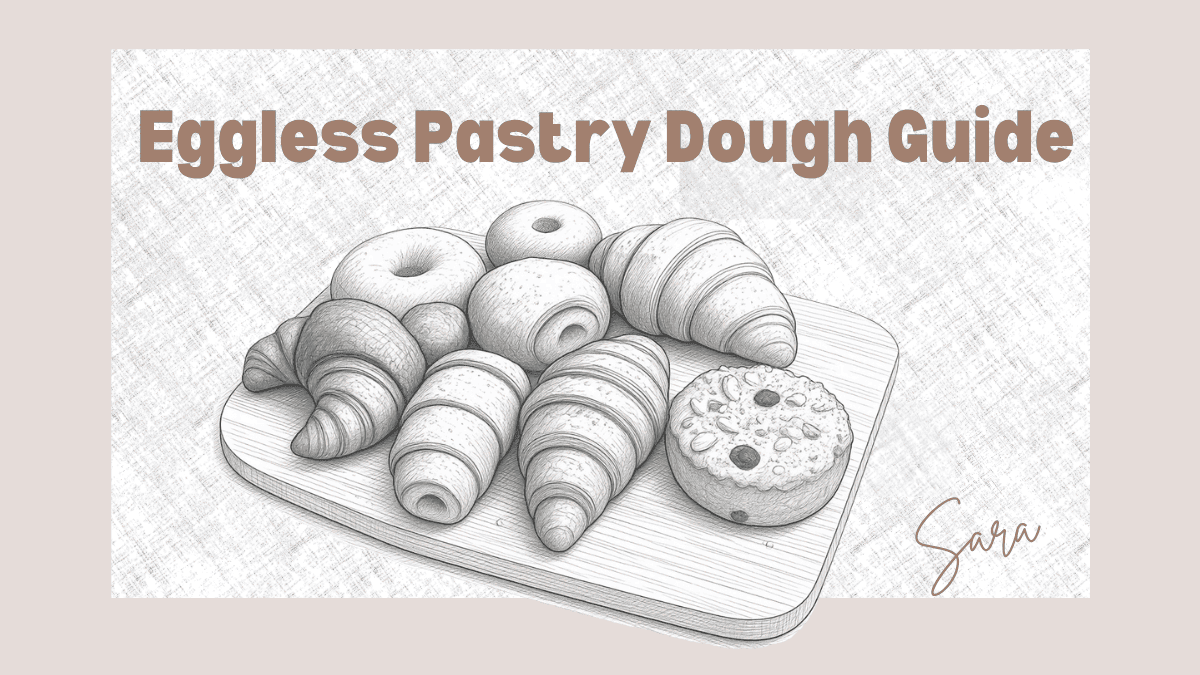
This guide breaks down six pastry doughs you’ll use again and again in the kitchen, what each one is actually for, and exactly what goes into making them—no eggs, no fuss.
(For all-purpose flour in these recipes, stick with Hecker’s, Pillsbury, or King Arthur ,they hold up consistently across these doughs.)
Eggless Pie Dough
What it’s for: Fruit pies, pumpkin pie, quiches (crust only), hand pies, and galettes.
This is the workhorse dough, flaky, slightly crumbly, and forgiving enough for a first-time baker. The classic French name is pâte brisée, but most people just call it pie crust.
Ingredients:
2 ½ cups all-purpose flour
1 cup cold unsalted butter, cubed
1 teaspoon salt
1 teaspoon sugar (optional, for sweet pies)
6–8 tablespoons ice water
Key technique: Keep everything cold ,butter, water, and even the bowl if your kitchen runs warm. Cold butter creates steam pockets as it bakes, which is what gives you those flaky layers. For shine on top, a milk or cream brush-on works just as well as an egg wash.
Eggless Shortcrust Pastry
What it’s for: Tarts, quiche shells, hand-held pastries, and sweet dessert shells.
Shortcrust is pie dough’s sturdier, sweeter cousin. It uses a higher ratio of fat to flour and sometimes a touch of sugar, which gives it a tender, almost cookie-like texture once baked, ideal for tarts that need to hold their shape without a filling propping them up.
Ingredients:
2 cups all-purpose flour
¾ cup cold unsalted butter, cubed
¼ cup sugar (omit for savory tarts)
¼ teaspoon salt
3–4 tablespoons cold water or cold milk
Key technique: Handle the dough as little as possible once the water goes in. Overworking develops gluten, and gluten is the enemy of “short” (tender, crumbly) texture here.
Eggless Puff Pastry
What it’s for: Turnovers, palmiers, vol-au-vents, wrapping baked brie, and pastry tops for pot pies.
Puff pastry gets its dramatic rise from lamination, folding butter into dough in thin layers, over and over, so it puffs into flaky sheets in the oven. Traditional puff pastry recipes are naturally eggless; the lift comes entirely from butter and steam.
Ingredients:
2 cups all-purpose flour
1 ½ cups cold unsalted butter, cut into slabs
½ teaspoon salt
½–¾ cup ice water
Key technique: This is a “book fold” dough. Roll it out, fold it into thirds like a letter, chill for 20–30 minutes, and repeat 4–6 times. Rushing the chilling steps is the most common reason puff pastry doesn’t puff.
Eggless Rough Puff Pastry
What it’s for: Same uses as puff pastry (turnovers, tarts, pie toppers), but for when you want most of the flakiness with a fraction of the effort.
Rough puff skips the precise butter-block lamination of true puff pastry. Instead, you toss cold butter cubes through the flour and fold the shaggy dough a few times , less technique, still very flaky results.
Ingredients:
2 cups all-purpose flour
1 cup cold unsalted butter, cubed
½ teaspoon salt
½ cup ice water
Key technique: Leave the butter pieces visibly chunky when you mix ,don’t cream it into the flour. Those chunks are what create the flaky layers as they melt and steam in the oven.
Eggless Choux Pastry
What it’s for: Cream puffs, eclairs, profiteroles, gougères.
Choux is the one dough on this list that traditionally relies on eggs for structure and puff, but you can absolutely make it without them using a simple starch-and-liquid swap that mimics the binding eggs normally provide.
Ingredients:
1 cup all-purpose flour
½ cup unsalted butter
1 cup water or plant milk
¼ teaspoon salt
1 tablespoon sugar (for sweet choux)
3–4 tablespoons cornstarch or arrowroot slurry (egg replacement for binding)
Key technique: Cook the flour into the melted butter and liquid on the stovetop until it forms a smooth ball that pulls away from the pan (this is called “drying” the dough) , this step matters even more without eggs, since it’s your main structure-builder here.
Phyllo Dough
What it’s for: Baklava, spanakopita-style hand pies, layered pastries, and crispy dessert cups.
Phyllo is naturally eggless and one of the simplest doughs on this list in terms of ingredients , the skill is entirely in the stretching. Most people buy pre-made phyllo sheets, but it’s worth knowing what’s actually in them.
Ingredients:
2 cups all-purpose flour
½ teaspoon salt
½ cup water
2 tablespoons oil
1 teaspoon vinegar (helps keep the dough elastic for stretching)
Key technique: Rest the dough for at least an hour before stretching , this relaxes the gluten and makes paper-thin sheets possible without tearing.
Quick Reference: Which Dough for Which Bake
| Dough | Texture | Best For |
|---|---|---|
| Pie Dough | Flaky, crumbly | Fruit pies, galettes |
| Shortcrust | Tender, sturdy | Tarts, quiche shells |
| Puff Pastry | Airy, layered | Turnovers, vol-au-vents |
| Rough Puff | Flaky, quicker | Pot pie tops, easy turnovers |
| Choux | Light, hollow | Cream puffs, eclairs |
| Phyllo | Paper-thin, crisp | Baklava, layered pastries |
FAQ
Can I substitute the egg wash on eggless dough? Yes , a brush of milk, cream, or melted butter gives a similar golden shine without eggs.
Does eggless pastry dough freeze well? All six of these freeze well unbaked. Wrap tightly and freeze for up to 3 months; thaw in the fridge overnight before rolling.
Why does my dough shrink when baking? Usually overworked gluten or skipping the chill step. Let dough rest in the fridge for at least 30 minutes before it goes in the oven